
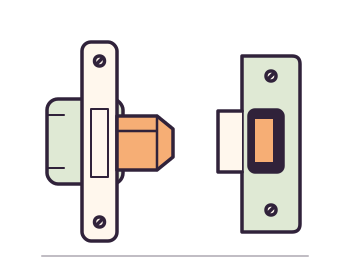
Describe the moment it catches
Does the key resist as you put it in, as you turn it or as you try to remove it? Does the handle move normally? A clear description is more useful than calling every problem a broken lock.
For lock repair in Inglewood, we look at supported hardware along with the door and frame. A lock is only one part of that assembly. The bolt or latch needs somewhere to go without being forced.
If a key has bent or a piece has broken away, keep the pieces. Avoid trying to force the remaining part or adding a mixture of products to the lock. Extra damage can make the original fault harder to sort out.
Open and closed can tell different stories
A key that turns easily with the door open but catches when it is shut may be reacting to pressure at the frame. That observation does not identify every cause, but it is a useful starting point.
A spare key is another comparison. If one key struggles and the other works well, the key itself may be involved. If both behave the same way, describe that too.
You don't need to remove a cylinder or adjust a strike plate to explain the problem. Tell us about any recent change: the door began rubbing, the handle loosened or the trouble appeared after a slam.
Repair, replace or change the key?
Repair aims to correct a fault. Replacement changes the hardware. Rekeying changes which key operates a compatible lock. Those can be related tasks, but they aren't substitutes for one another.
If the lock works smoothly and the worry is an old key in someone else's hands, a key change may be enough. If a part is worn, broken or unavailable, new hardware may be a more sensible option.
A new lock still needs to suit the door. Measurements, existing holes, the way it closes and the function you need all matter. Choosing by appearance alone can leave a door awkward to use.
The last check should feel ordinary
A repaired entrance should be tested the way it is used. For a home, close it normally and try the lock. For a business, check that the door catches rather than merely reaching the frame.
A shop near Market Street may also have a closer affecting how the door returns. The key cylinder, latch, closer and frame each have a part to play. Scope for commercial door work should be checked for the actual hardware.
Point out anything that still feels stiff before the visit ends. You shouldn't need to learn a new trick for making the repaired lock work. Keep the receipt and ask which warranty terms apply to the work or parts supplied.